
Introduction & Rationale
Inclusion in adult education is a cornerstone of European policies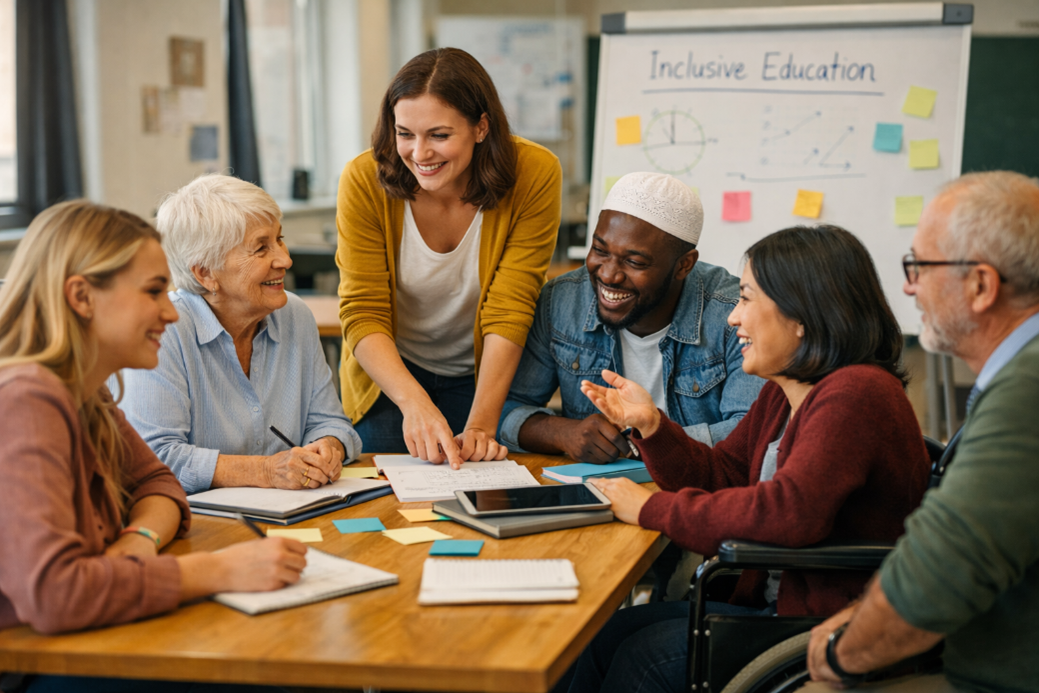 and practices, highlighting the urgent need to build learning systems that are fair, relevant, and accessible to everyone, regardless of race, gender, age, or background. Contemporary societies are shaped by digital transformation, migration, and demographic ageing, creating both challenges and opportunities for adult learners.
According to the UNESCO Global Report on Adult Learning and Education (2022), inclusive education policies are closely linked to employability, social cohesion, and adults’ ability to adapt to rapid change. Similarly, the European Commission (2020) emphasises that adult education must go beyond basic skills such as literacy and numeracy and include intercultural learning, social participation, and digital empowerment.
Exclusion from adult learning opportunities often reinforces existing inequalities. Vulnerable groups such as migrants, refugees, Roma communities, older adults, and people with disabilities are disproportionately affected by limited access to inclusive and high-quality education. The OECD Skills Outlook (2023) highlights that adults with low skill levels are three times more likely to be unemployed and twice as likely to experience social isolation. Therefore, inclusive adult education is not only about learning outcomes; it is also about dignity, empowerment, and the right to equal participation in education and citizenship.
This module recognises that inclusion is both a principle and a practice. As a principle, it promotes fairness and equal opportunity. As a practice, it must be embedded in curricula, institutional policies, teaching materials, and daily educational interactions. The rationale for centring this module on inclusion is to ensure that no adult learner is excluded from educational and digital opportunities. As demonstrated in the above-mentioned reports (UNESCO, 2022; European Commission, 2020; OECD, 2023; Council of Europe, 2022), inclusive education strengthens communities and reduces structural discrimination.
What learners will learn / Skills & Competences gained
- Develop stronger intercultural competences by showing respect for diversity, practising empathy, and resolving conflicts constructively in cross-cultural interactions.
- Strengthen social skills through effective communication, collaborative teamwork, and active participation in community initiatives.
- Use essential digital tools and technologies to access information, communicate effectively, and participate confidently in digital society, supporting their digital inclusion.
- Build self-confidence and resilience by applying strategies that enhance self-efficacy in new social and professional contexts.
- Develop basic civic and advocacy skills to participate more actively in democratic processes and community decision-making.
Theoretical Justification
Why does inclusion matter today?
Excluding adults from digital education and limiting their access to digital skills in work, education, and public life increases social inequalities. Research (European Commission, Digital Education Action Plan, 2020) shows that digital divides often lead to broader social divides. According to UNESCO (2022), digital literacy is becoming a prerequisite for active participation in society and decision-making processes, making inclusive access to digital learning essential.
Furthermore, evidence confirms that inclusive adult education improves employability, civic engagement, and overall well-being. The OECD Skills Outlook (2023) indicates that adults engaged in lifelong learning have higher employment rates, better mental health outcomes, and stronger civic participation. The Council of Europe (2022) also highlights inclusive education as a key factor in building democratic and resilient societies.
From the perspective of social cohesion, inclusive learning environments foster intercultural dialogue and peaceful coexistence. As former UN Secretary-General Kofi Annan stated, “The United Nations was created in the belief that dialogue can triumph over discord, that diversity is a universal virtue and that the peoples of the world are far more united by their common fate than they are divided by their separate identities” (United Nations). UNESCO further defines intercultural dialogue as a transformative process grounded in mutual respect, empathy, and openness to different perspectives (UNESCO). In multicultural and ageing societies, preventing marginalisation and promoting solidarity are essential. Studies (UNESCO, 2019; European Skills Agenda, 2020) confirm that inclusive education directly supports SDG 4 (Quality Education) and SDG 10 (Reduced Inequalities).
In terms of policy alignment, the EU’s European Education Area (2025 target) states that at least 47% of adults aged 25–64 should participate in learning activities within a 12-month period. The European Education Area recognises inclusion as a strategic priority, emphasising that employability skills must be combined with civic and sustainability competences. Adult education is therefore not only a workforce policy but also a long-term social investment that strengthens democracy and well-being.
In summary, promoting inclusion in contemporary societies is fundamental to creating equal opportunities, particularly in access to learning. Inclusive adult education enables individuals not only to cope with rapid change, but to thrive as active, informed, and engaged citizens (OECD, 2023; UNESCO, 2022; European Commission, 2020; Council of Europe, 2022; European Skills Agenda, 2020).